Dell PowerEdge / Cisco UCS
Server infrastructure for the compute capacity your recovered applications need.

Protect a recovery copy. Restore critical applications. Run them in Contour Cloud. Air-Gapped Tertiary Site Recovery combines an isolated vault with enterprise IaaS, giving your business an alternate place to operate while your primary environment recovers.
Preserving data is part of the plan. Applications also need somewhere to run.
When production systems become unavailable or untrusted, a recovery copy needs a usable destination. AGSR brings an isolated tertiary copy together with Contour Cloud compute, storage, and networking, planned around the workloads your business needs first.
See how IaaS supports continuityExplore how data moves into the vault, how teams test recovery, and where priority workloads can operate.
Critical applications
and protected data
Receive selected copies
and recovery points
Separately controlled
recovery copies
A recovery destination with compute, storage, and networking sized for priority workloads.
Selected data enters through a controlled transfer path. The agreed isolation method separates the vault from production connectivity between transfers.
Illustrative architecture. The actual isolation method, transfer cadence, platform compatibility, and recovery capacity are established during solution design.
Give critical applications a destination before an incident. Contour Cloud Infrastructure as a Service (IaaS) brings together compute, storage, networking, and virtualization to run selected recovered workloads while your primary environment is investigated and rebuilt.
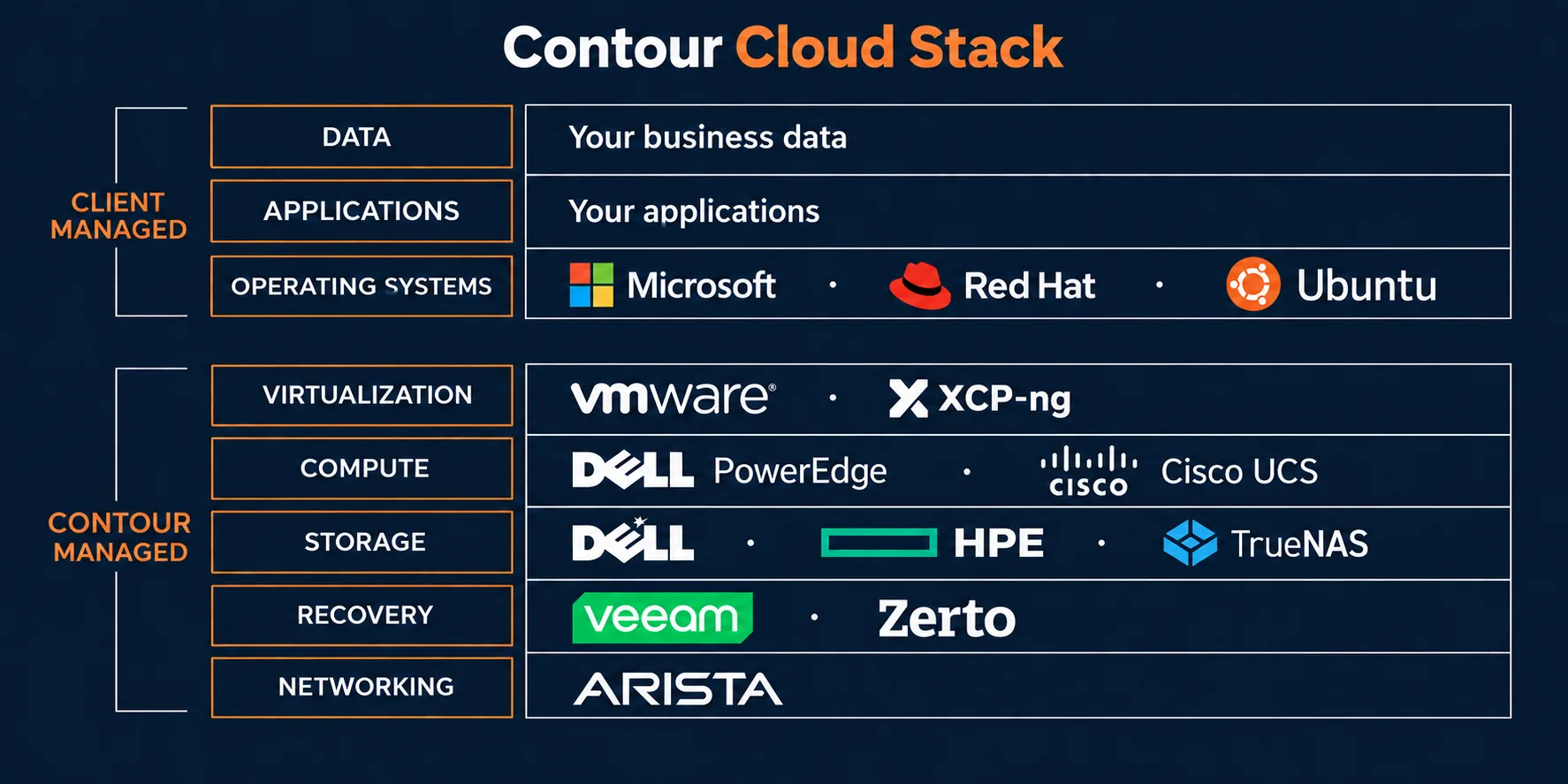
Dell PowerEdge and Cisco UCS compute, VMware and XCP-ng virtualization, and Arista networking form the foundation for an alternate operating environment. Zerto supports replication and recovery workflows where selected for your design. The isolated vault and the environment running your applications remain separate.
Explore the IaaS foundation Plan your priority workloadsBuild the recovery destination around the applications you need to operate: their capacity, connections, access requirements, and dependencies.
Server infrastructure for the compute capacity your recovered applications need.
Virtualization platforms to host selected workloads in the Contour Cloud recovery environment.
Data center networking connects recovery compute, storage, and the services your applications rely on.
Replication and recovery workflows for supported workloads, with recovery points and procedures defined in your plan.
Storage options sized for application data, recovery testing, and the agreed operating period, with capacity and performance defined for your workloads.
Define segmentation, approved access, and connectivity for users and application dependencies.
Your solution design defines platform compatibility, licensing, capacity readiness, and recovery objectives for the selected workloads.
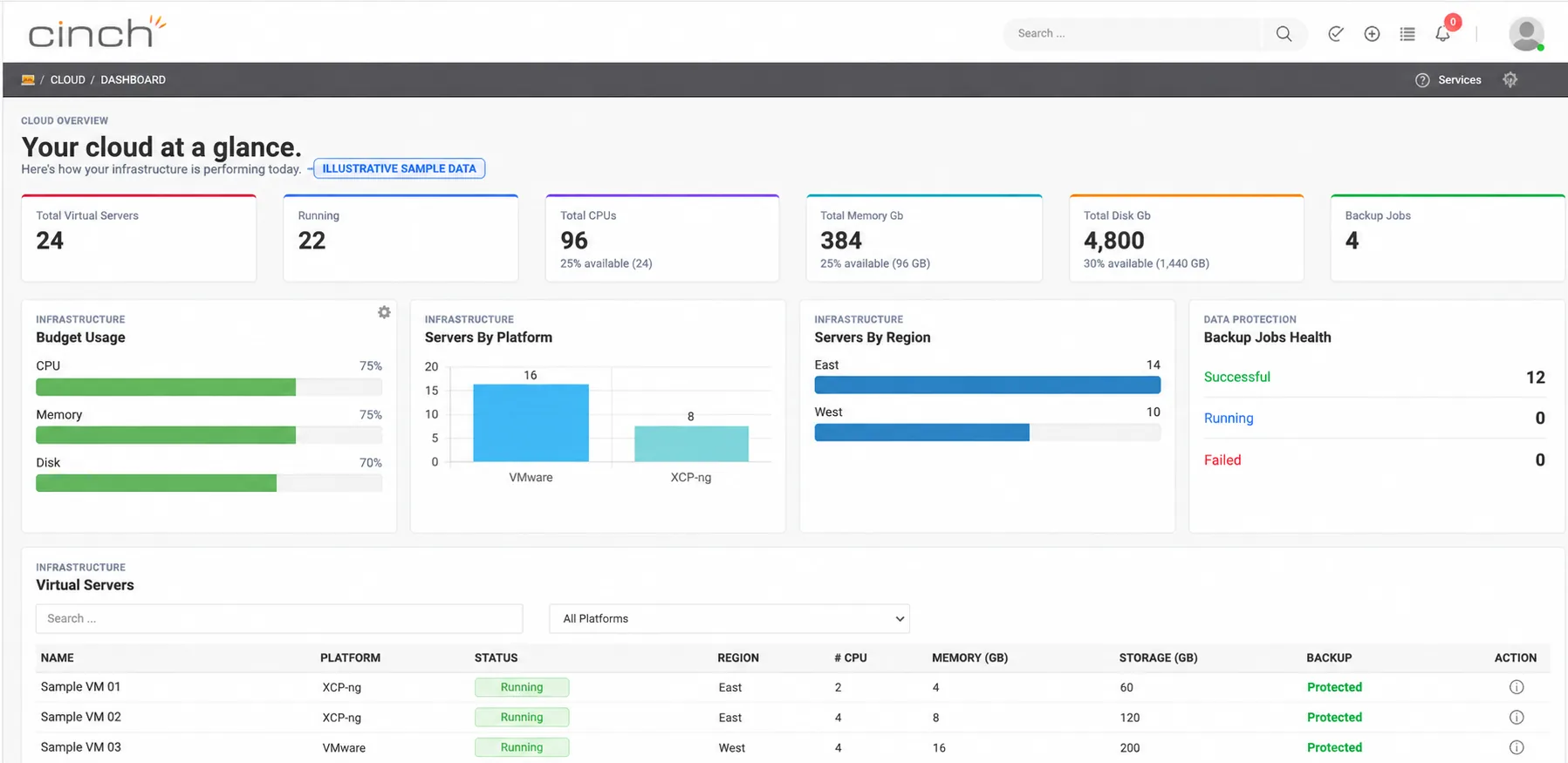
View cloud resources, inspect workloads, and access self-service orchestration through Cinch. Explore this sample dashboard to see how infrastructure visibility supports everyday operations and recovery planning.
Illustrative environment · Example data
| Name | Platform | Status | Region | vCPU | Memory | Storage | Protection | Details |
|---|
Cinch brings infrastructure visibility and self-service orchestration into one cloud management experience. Available actions depend on your permissions and service configuration.
Review workloads across platforms and regions, with CPU, memory, storage, and status in view.
See allocated resources and capacity information to inform operating and recovery plans.
Access cloud IaaS and self-service orchestration, with available functions determined by your service and role.
Define the controls around the recovery copy, its access, and the way it returns to service.
Define the transfer path and how it disconnects from production between transfer windows.
Establish vault access roles and recovery approvals apart from everyday production administration.
Choose retention and encryption controls, with immutability where the selected platform supports it.
Test candidate recovery points and application dependencies before bringing workloads into operation.
Contour works with your team to define the protected workloads, the tertiary site, and the steps required to resume critical operations.
Workload scope, priorities, recovery objectives, dependencies, retention, and responsibilities.
The landing zone, transfer workflow, vault controls, and recovery infrastructure defined in your design.
Visibility into agreed service components, detected exceptions, escalation, and recovery assistance within the selected scope.
Documented runbooks, validation of selected workloads, and a planned return to the primary environment.
The design can draw on these platforms, selected and validated for your environment.



Technology selection and recovery workflows are designed around your workloads and service requirements.
These are possible design components. They do not represent a universally compatible bundle.
AGSR combines a separately controlled recovery copy with an alternate recovery destination. With IaaS included and configured, selected validated workloads can operate in Contour Cloud while the primary environment is investigated and rebuilt. The scope and operating duration are agreed in advance.
The design must define the isolation controls and the transfer process. A different location or a replicated copy alone does not establish the isolation method. Your design documents how connections close and who can access the vault.
Timing depends on data volume, transfer cadence, recovery capacity, security review, application dependencies, and required decisions. RPO and RTO targets are defined for in-scope workloads. They become service commitments only when the service order expressly includes them.
Capacity readiness is a design decision. The service order defines what resources are included, how they become available, their operating duration, and any activation or usage charges.
Contour evaluates your current platforms, workload formats, connectivity, and licensing before selecting the technology mix. Compatibility and recovery steps require validation for each design.
Talk with Contour about an isolated tertiary site and the cloud infrastructure your priority workloads may need.
Talk to an ExpertBring your priority applications, current recovery design, and business objectives. We’ll discuss:
A global food manufacturer uses Contour Secure Cloud: Air-Gapped Tertiary Site Recovery (AGSR) to add an isolated recovery layer and an alternate place to run priority business applications.
Two active-active data centers support applications used across the global business. In this example, recovery priorities include identity services, ERP, inventory and warehouse systems, and order processing.
If an incident affects both data centers or their shared access, the team needs a recovery copy outside that exposure—and infrastructure where selected applications can run while the primary systems are investigated and rebuilt.
Selected recovery copies move through a controlled transfer process into Contour’s isolated tertiary vault. The recovery plan defines isolation controls, retention, access, and the capacity needed in a separate Contour Cloud IaaS environment.
Active
Active
Separately controlled recovery copies
Compute, storage, and networking for selected recovered applications
Contain the incident and select candidate recovery points with the response team.
Test selected applications and dependencies in the separate recovery environment.
Run approved priority workloads on IaaS and reconnect sites through planned access.
Transition workloads back when the primary environment is ready.
The manufacturer can plan how essential business systems resume service across its sites while remediation continues. Cinch provides visibility into the cloud resources and workloads supporting that recovery.
Illustrative scenario, not a named customer case study or a statement of achieved results. Workload priorities, site connectivity, recovery capacity, and recovery objectives are defined during solution design.
Explore the AGSR approach or ask Contour to help map your workloads, sites, and recovery priorities.